ADVOCATES FOR THE WEST
CENTER FOR BIOLOGICAL DIVERSITY
CONSERVE SOUTHWEST UTAH
CONSERVATION LANDS FOUNDATION
SOUTHERN UTAH WILDERNESS ALLIANCE
THE WILDERNESS SOCIETY
WILDEARTH GUARDIANS
FOR IMMEDIATE RELEASE
May 11, 2026
Northern Corridor Highway Risks Irreversible Harm to Mojave Desert Tortoise – 5.11.26
Conservation Groups Amend Lawsuit over Federal Agencies’ Failure to Protect Threatened Wildlife in Reapproving Controversial Highway
Contacts:
Grant Stevens, Communications Director, Southern Utah Wilderness Alliance (SUWA); (319) 427-0260; grant@suwa.org
Washington, DC – Conserve Southwest Utah, along with six Utah-based and national conservation organizations, amended their February lawsuit today over the Bureau of Land Management (BLM) and U.S. Fish and Wildlife Service’s failure to adequately protect the threatened Mojave desert tortoise when reapproving the Northern Corridor Highway in January 2026. The long-opposed highway would tear through critical habitat for the Endangered Species Act (ESA)-protected tortoise within Red Cliffs National Conservation Area near St. George, Utah.
In addition to other laws, the newly filed complaint alleges new violations of the ESA by the Fish and Wildlife Service and BLM — including for the unlawful disposal of lands purchased using federal funding intended to protect the tortoise to make way for the highway. Fish and Wildlife Service’s final environmental analysis supporting the land disposal was issued on the same day in February 2026 that the conservation groups, represented by Advocates for the West, filed their lawsuit challenging the illegal highway’s reapproval. The amended complaint was filed now to comply with the required 60-day notice to federal agencies of ESA violations.
“The proposed Northern Corridor Highway would carve through one of the last strongholds of the threatened Mojave desert tortoise, permanently destroying the very habitat this species needs to survive,” said Stacey Wittek, Conserve Southwest Utah’s Executive Director. “St. George can have smart economic growth without accelerating the irreversible loss of a species already on the brink of extinction.”
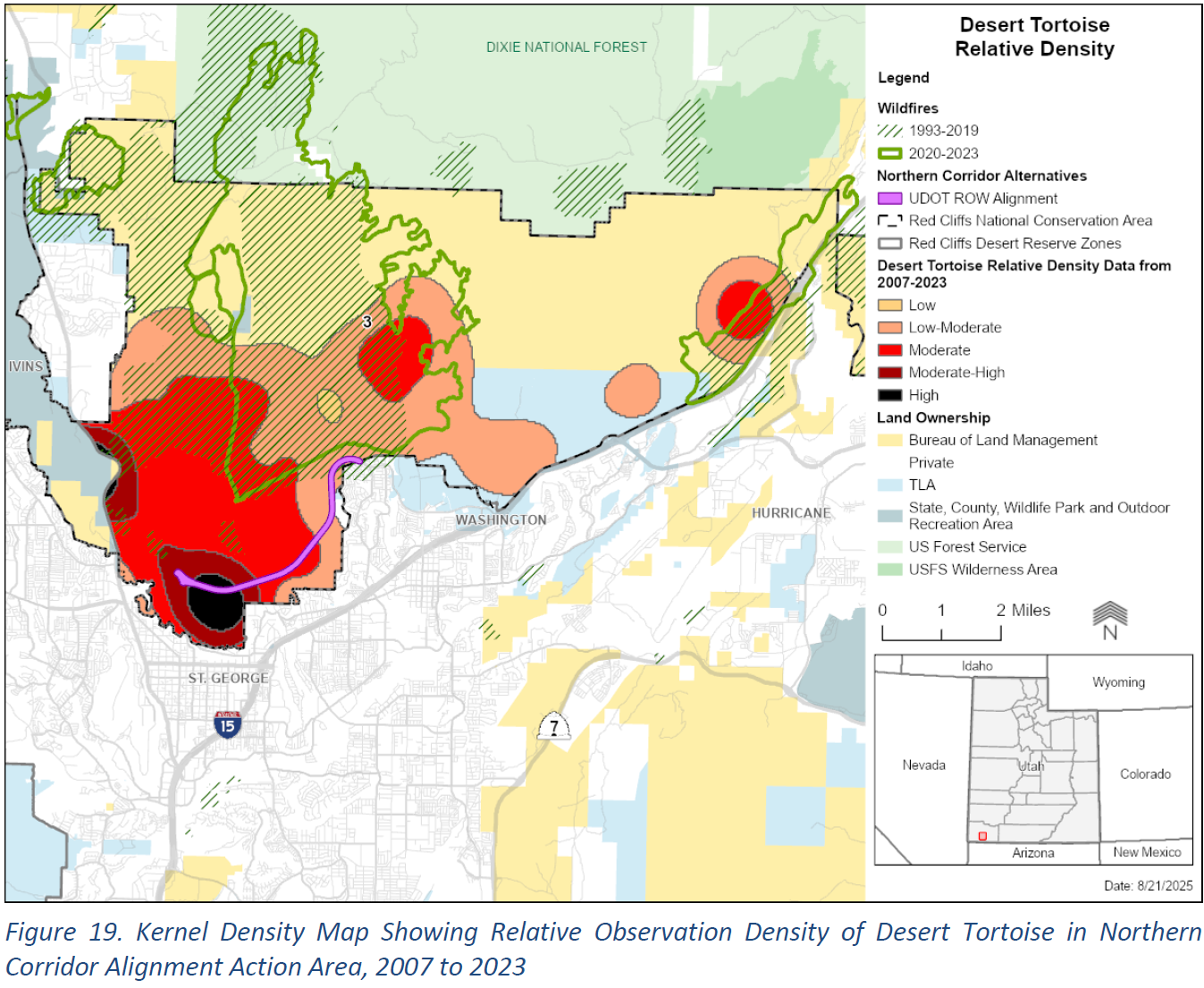
The Mojave desert tortoise is a keystone species, providing the supporting structure and stability for its desert environment. Its population decline signals significant risk for the overall ecological health of the desert. The number of tortoises within the core of the Red Cliffs Desert Reserve has declined over 50% since 1998, and the proposed Northern Corridor Highway would bisect the only remaining high-density cluster of tortoises in the Reserve.
“The federal agencies’ environmental analysis has shown that punching a high-speed highway through Red Cliffs National Conservation Area would permanently eliminate designated tortoise habitat and increase threats like wildfire and invasive species,” said Hannah Goldblatt, staff attorney at Advocates for the West and counsel for the conservation groups. “Moving forward anyway ignores both science and the law — and pushes the Mojave desert tortoise closer to extinction.”
Conservation groups’ amended complaint follows the U.S. District Court’s issuance of an injunction this March prohibiting the Utah Department of Transportation (UDOT) from starting construction-related activities that would cause irreparable harm to the ESA-protected tortoise.
A Route Rejected Seven Times
The Department of the Interior has rejected the controversial Northern Corridor Highway route seven times, determining that it would be “biologically devastating” to the threatened Mojave desert tortoise.
Since 2006, local residents have also strongly opposed the highway, pointing out transportation alternatives outside of Red Cliffs National Conservation Area that would do a better job of relieving traffic congestion, supporting economic growth and protecting wildlife, scenic beauty and local access to trails.
Despite the immense local opposition, the BLM and Fish and Wildlife Service approved a right-of-way for the Northern Corridor Highway in the final days of the first Trump administration. Conservation groups sued, arguing that the approval violated multiple federal laws.
In 2021, 6,800 acres west of St. George designated “Zone 6” were added to the Red Cliffs Desert Reserve as mitigation for the Northern Corridor Highway. Zone 6 contains the Greater Moe’s Valley outdoor recreation area, and its ownership is split between the BLM and the state Trust Lands Administration. While conservation groups support protection of the Moe’s Valley area for both recreation and conservation, they agree with federal agencies’ assessment that its geographic isolation from the rest of the tortoise’s protected habitat, along with other factors, diminishes its conservation value and does not adequately offset the damage caused by the Northern Corridor Highway.
Conservation groups’ 2021 lawsuit resulted in a settlement agreement and a U.S. District Court decision sending back the project’s right-of-way approval for reconsideration. Agencies acknowledged that the approval did not comply with the law and required additional environmental analysis in light of recent wildfires that further degraded Mojave desert tortoise habitat and native vegetation. After updating its environmental analysis, the BLM rejected the project in late 2024.
The agency’s2024 Supplemental Environmental Impact Statement found the project would permanently eliminate designated critical tortoise habitat, increase wildfire probability and frequency, spread noxious weeds and invasive plants, and harm more cultural and historical resources than any alternative considered.
In October 2025, the BLM said it would reconsider the highway right-of-way application after UDOT argued that the federally endorsed alternative was not economically viable, despite documented environmental and community costs associated with the Northern Corridor.
Abandoning their previous scientific findings, the BLM and Fish and Wildlife Service reapproved the Northern Corridor Highway in January 2026. The decision reverses federal agencies’ December 2024 rejection of the same proposal and marks the eighth time the controversial highway has been considered.
Conservation groupssued in February 2026, challenging federal agencies’ reapproval of UDOT’s highway proposal for violating multiple federal laws, including the Omnibus Public Land Management Act, Land and Water Conservation Fund Act, Endangered Species Act, and National Environmental Policy Act.
About Red Cliffs National Conservation Area
The 44,724-acre Red Cliffs National Conservation Area overlaps the larger Red Cliffs Desert Reserve, which is jointly managed by the BLM, the Fish and Wildlife Service, the state of Utah, Washington County, and local municipalities. The reserve was established under a 1995 Habitat Conservation Plan as a compromise to protect roughly 61,000 acres of public lands for the threatened Mojave desert tortoise while allowing development on about 300,000 acres of state and private land. Congress designated the Red Cliffs National Conservation Area in 2009 to “conserve, protect, and enhance for the benefit and enjoyment of present and future generations the ecological, scenic, wildlife, recreational, cultural, historical, natural, educational, and scientific resources” of the public lands within the unit.
The region supports key populations of the threatened Mojave desert tortoise and other at-risk plants and animals, including the Gila monster, burrowing owl, and kit fox. Researchers say the Mojave desert tortoise is on a path to extinction, and its habitat in southwest Utah –– which houses some of the densest tortoise populations –– is especially vulnerable amid rapid growth in the region.
Additional Information and Resources:
- Informational website: protectredcliffs.com
- Lawsuit Challenges Illegal Highway Through Utah’s Red Cliffs National Conservation Area – February 4, 2026
- Federal Agency Re-Approves Highway Through Red Cliffs National Conservation Area, Abandons Own Scientific Findings – January 21, 2026
- BLM Again Considering Four-Lane Highway Through the Red Cliffs National Conservation Area – October 7, 2025
- Decades-Long Highway Fight Ends with Victory for Red Cliffs NCA – December 20th, 2024
- Local and National Organizations Applaud Plan Signaling Denial of Highway Right-of-Way – November 7, 2024
- Conservation Organizations Respond to Washington County’s Continued Attacks on Red Cliffs National Conservation Area – August 7, 2024
- Federal Agencies Release Draft Supplemental Environmental Impact Statement on a Highway Right-of-Way Through Red Cliffs National Conservation Area – May 9, 2024
- BLM and FWS Press Release – November 15, 2023
- Report – Washington County at a Crossroads: An analysis of the proposed Northern Corridor Highway project in Southwest Utah
- Summary of Desert Tortoise Study in Red Cliffs NCA: Population Trends, Threats to Persistence, and Conservation Significance
###
The Southern Utah Wilderness Alliance (SUWA) is a nonprofit organization with members and supporters from around the country dedicated to protecting America’s redrock wilderness. From offices in Moab, Salt Lake City, and Washington, DC, our team of professionals defends the redrock, organizes support for America’s Red Rock Wilderness Act, and stewards a world-renowned landscape. Learn more at www.suwa.org.