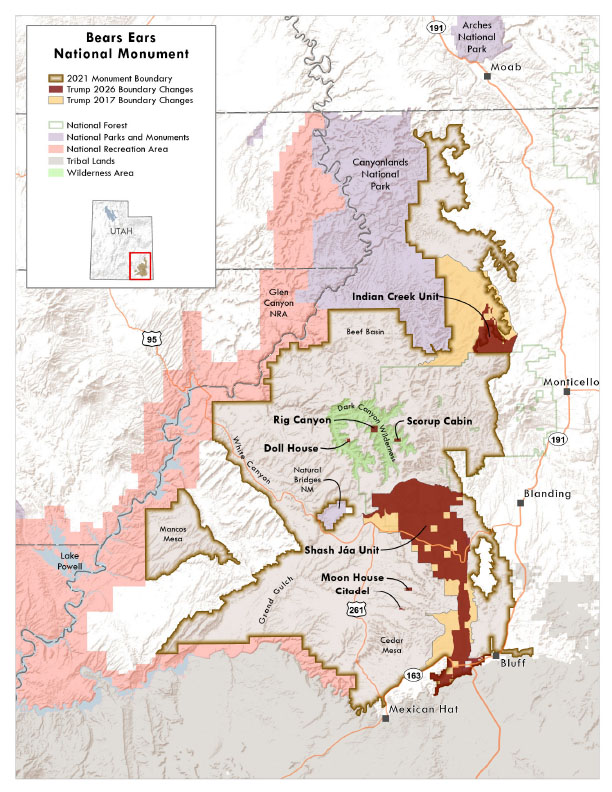
Since day one of President Trump’s second term in office, we’ve known that Grand Staircase-Escalante and Bears Ears National Monuments would again be in the crosshairs, and that Trump would likely attempt another illegal national monument boundary reduction. This summer, those fears came true. On July 13, President Trump signed two executive orders slashing the monuments by a combined 3 million acres, or nearly 90% (yes, you read that right).
- Grand Staircase-Escalante went from 1.87 million acres to about 181,500 acres.
- Bears Ears went from 1.36 million acres to about 121,100 acres.
Alongside President Trump in the Oval Office that day stood Utah Governor Spencer Cox and every member of the state’s congressional delegation: Senators Mike Lee and John Curtis, and Representatives Celeste Maloy, Mike Kennedy, Blake Moore, and Burgess Owens. They stood by nodding and grinning smugly as the president blatantly lied, saying of the monuments, “[You] can’t do anything. You can’t go hunting. You can’t go fishing. You can’t do anything. You can virtually not even walk on it.” To state what is obvious to most, hiking and camping are common and popular activities in both monuments, and hunting and fishing are explicitly allowed (and managed by the state).
Rather shockingly, Deputy Secretary of the Interior Kate MacGregor, who unquestionably knows better, agreed with Trump’s outrageous statements. Sen. Lee, with a look of unconstrained glee, chimed in with his requisite Antiquities Act talking points. Rep. Maloy, apparently tasked with providing political cover, explained that county commissioners have for years clamored to throw off the yoke of federal control and let the locals, who surely know best on such matters, better manage these special lands.
Rep. Moore passed on adding to this dubious chorus, but Sen. Curtis, the so-called “Conservative Climate Champion,” offered a reminder that Utah is horribly burdened by so much public land. Finally, outgoing Rep. Owens lamented the back-and-forth cuts and restorations of the monuments; then, seemingly without irony, he praised the latest cuts.
A Gift to Private and Corporate Interests
Compared to Trump’s 2017 attempted reductions, which were egregious enough, the latest executive action subtracts an additional 1 million acres, making it one of the largest wholesale rollbacks of public land protections in history. The new Bears Ears proclamation disbdanded the Bears Ears Commission, ending the federal government’s commitment to work directly with the five Tribes that proposed and continue to protect that monument; in its place is an advisory committee made up of fifteen members, including one member from each of the five Tribes, six members recommended by the Utah governor, and representatives from local governments.
If you’ve visited either of the monuments, some of your favorite places have likely been cut, including Coyote Gulch, Peek-a-Boo and Spooky slot canyons, Fiftymile Mountain, Grosvenor Arch, and the Paria-Hackberry in Grand Staircase-Escalante, and Cedar Mesa/Grand Gulch, White Canyon, Elk Ridge, Butler Wash, and Valley of the Gods in Bears Ears (see maps on pages 8-9).
One might ask: what could possibly motivate the Utah congressional delegation to advocate and applaud (quite literally) the evisceration of two national monuments in their own state—monuments for which polling consistently shows overwhelming support in Utah and across the nation? Here’s a clue: on September 11, the 3 million acres removed from the monuments will be vulnerable to new mining claims, oil and gas leasing, and coal and geothermal development. They will also become eligible for sale or disposal under existing federal law. Even the lands that remain “protected” will be monuments in name only, managed primarily to
- Expand motorized vehicle access and reopen some roads that were previously closed to protect cultural and natural resources.
- Increase livestock grazing and require unused grazing permits to be reissued rather than retired for habitat restoration.
- Encourage logging, infrastructure development, and other commercial uses whenever possible.
In other words, this is a naked power grab by Utah politicians who fundamentally oppose the concept of protected public lands.

Never Underestimate the “Protect Wild Utah” Movement
SUWA was ready for this moment, and we will fight for the monuments in every way we can using every tool in our toolbox for as long as necessary. Here are some examples of how we’re already responding:
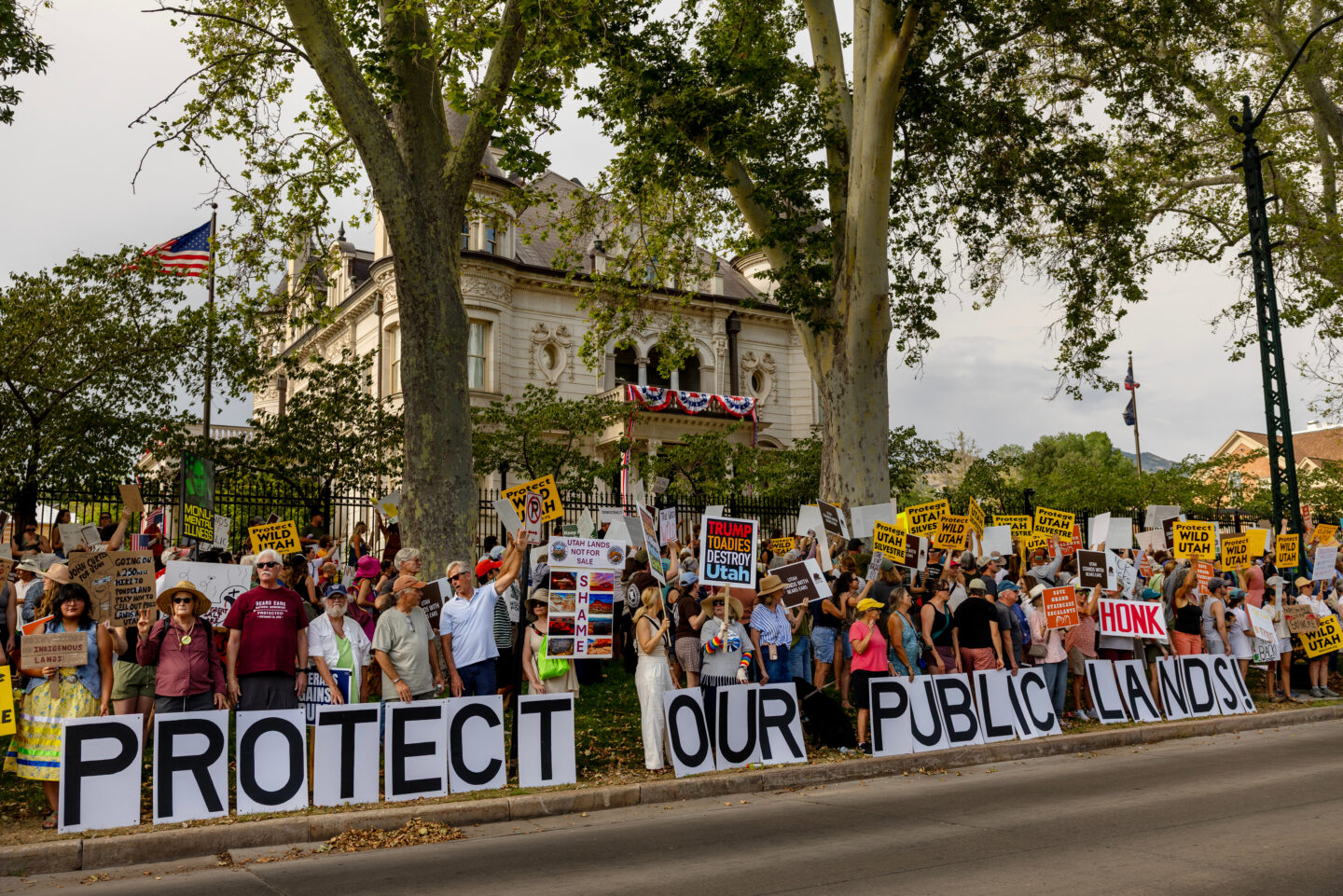
- A week after Trump’s unlawful action, SUWA and our partners hosted a Statewide Monumental Day of Action in Utah, with over a thousand people turning out in 100-degree heat to attend events in Salt Lake City, Ogden, Provo, Moab, St. George, Bluff, and Boulder.
- We will take Trump to court over these illegal reductions, as we did in 2017 (that case was not resolved by the time President Biden restored the monuments in 2021). As of publication, we’re coordinating with conservation partners and Tribal nations to determine a litigation strategy based on the new proclamations.
- We’re ramping up our efforts to promote America’s Red Rock Wilderness Act, which would protect much of the land included in the monuments as wilderness.
- We’re shining a light on the disinformation spread by Trump and the Utah congressional delegation. SUWA staff have already been quoted or interviewed in the New York Times, the Washington Post, the Salt Lake Tribune, Utah News Dispatch, KUER, Outdoor Life, Rocky Mountain Community Radio, and many other news outlets.
In moments like this, it’s easy to feel despair, and we understand why. There are many hard days and hard fights ahead—more weeks and months that will test our resolve to do the difficult work that can feel like one step forward, two steps back. But SUWA and the Protect Wild Utah movement are in this for the long haul, and we have a proven track record of defending the redrock against long odds. For example, our successful defense of the Grand Staircase-Escalante management plan from a recent legislative attack by some of the same Utah politicians (see below) is significant because it means that plan will remain in place for all the lands that comprised the 2025 monument until a new one is created.
We’re able to do the hard work of building powerful political support for public lands in Utah because we have so many passionate supporters like you nationwide. We’ll be calling on you again soon to reach out to your members of Congress, to spread the word about threats to Utah’s wild places, to join us in on-the-ground landscape protection, and more. We’ll share updates as we continue to fight every day for the places we all love. SUWA has never backed down from a hard fight and we’re not going to start now.
Why Our Recent Congressional Review Act Victory Matters
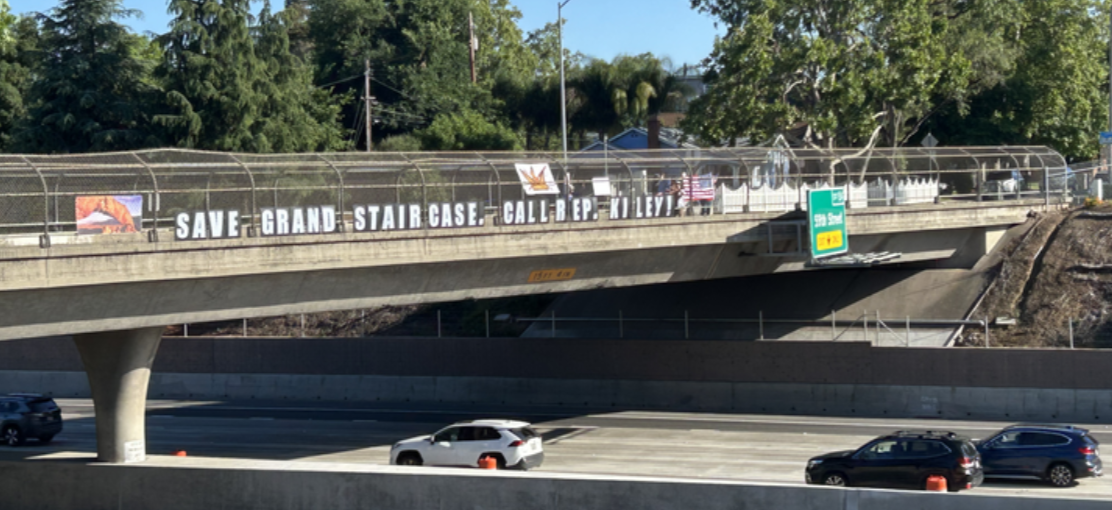
On June 11, just a month before the monument reductions, the fast-track attempt by Senator Lee and Representative Maloy to undo the Grand Staircase-Escalante National Monument Management Plan failed! This is a major—if now bittersweet—victory for the entire Protect Wild Utah movement, public lands advocates across the country, and most importantly, the landscape itself. Tribes and Tribal voices, faith leaders, business owners, scientists, and tens of thousands of everyday people across the country spoke with one determined voice against this extremely unpopular effort—and won. As a result, even as the boundaries of the monument have been altered, the management plan remains in place.
Here’s how it all unfolded. In March, Sen. Lee and Rep. Maloy introduced joint resolutions under the Congressional Review Act (CRA) to disapprove the monument management plan. If the resolutions were to pass, the management plan—which sets the terms for how the monument is managed for recreation, camping, and outdoor access; dark night skies; grazing; and other uses in collaboration with Tribal nations—would be undone, and the Bureau of Land Management (BLM) would be barred from issuing another management plan that is “substantially the same” in the future.
The CRA contains a provision that allows the Senate to pass a “joint resolution of disapproval” by a simple majority vote, but it must act within 60 Senate session days. Thursday, June 11, was day 60, meaning Sen. Lee’s resolution is now subject to the 60-vote filibuster. Should he bring it up for consideration, we are confident it will not pass.
For the first six months of 2026, defeating the Grand Staircase-Escalante CRA resolution was SUWA’s #1 priority. Our grassroots organizing team led efforts to reach persuadable members of Congress, fanning out across the country and working with members and supporters to hold in-district meetings with congressional staff (more about this below). We became experts in arcane congressional procedures. We worked with the Grand Staircase-Escalante Inter-Tribal Coalition and brought Tribal leaders, grassroots activists, and local business owners to Washington, DC. We coordinated with friends in the conservation and recreation communities. SUWA’s Utah-based staff were frequent visitors to Washington, working day in and day out with our DC Team.
This victory was far from guaranteed; Republicans have used the CRA six other times during this Congress to undo land management plans and a seventh time to undo a protective mineral withdrawal at the headwaters of the Boundary Waters Canoe Area Wilderness. The odds were stacked against us, with Republicans controlling the House, the Senate, and the White House. By raising your voice in opposition to Lee and Maloy, you made a difference.
While there was no one silver bullet to defeating the CRA resolution, we firmly believe that a key element was the work of SUWA and our partner organizations, such as the Sierra Club, to galvanize the Protect Wild Utah movement nationwide—and especially in congressional districts where we hadn’t done that before. Whether it was attending in-district meetings, dropping off materials at congressional offices, making phone calls, joining virtual meetings, or submitting letters to the editor of local news outlets, SUWA’s Organizing Team took on a herculean task—and delivered! Below, our organizers take a moment to share reflections on the whirlwind of the past few months. Lessons learned and relationships built will carry us through the next fight.
—Grant Stevens

Reflections from SUWA Organizers
Jenny Holmes, West Coast Organizer
Starting from nearly scratch in some places meant putting in even more effort than usual to reach possible activists. Following up on a lead often started a chain of connections and conversations—and we had to be incredibly creative. For example, in just one weekend we tabled at a flea market, talked with people in a park, participated in a church service, and joined Earth Day events. Staff from different teams within SUWA helped make phone calls, and everyone in the organization identified friends, family, and acquaintances in target districts.
In the course of building a new network of people and organizations, amazing new grassroots activists have emerged. This includes people who had never been in a meeting with their member of Congress before; they were driven to step out of their comfort zone by love for their public lands in general, or from a direct experience with the monument itself. Endurance, consistency, and persistence were common themes, from both activists and staff. I’m excited to keep working with our new activists on whatever opportunities and challenges come next!
Kaya Tate, Southwest Organizer
When I think back on this work, I’ll tell new organizers about the group of very stubborn, humorous, and disappointed but hopeful people I worked with. I’ll tell them about the activists who showed up at a congressional office demanding a meeting after months of meeting requests went unanswered. About the diverse interests, backgrounds, tempers, and personalities fighting for the monument—individuals who choose to devote an immense amount of time to the effort and did so in creative and authentic ways.
The amount of energy I saw poured into fighting for the monument was stunning and created a level of collective vigilance that allowed me to feel less alone, less intimidated, and hopeful. I will look back and remember the folks who, despite deep mistrust of their congressional members, showed up to advocate for their favorite non-human species or geologic feature, or for the sake of wild lands in general. There were many moments of quiet rage, productive cynicism, and unnoticed persistence that shaped this campaign and contributed to our eventual victory, and I’m grateful to have a few stories to remember it by.
Chris Riccardo, Midwest Organizer
For me, organizing in Omaha was a good reminder that you don’t need a huge crowd to get something moving; you just need a person or two willing to say “Sign me up! I’ll help.” From there, people brought friends, connected us with organizations, showed up to meetings, and found their own ways to plug in. Approaching this effort without a strong network of regional allies, it pushed me to think a little differently about where support might come from.
Some of the strongest advocates we found weren’t necessarily the folks I would have expected at the start. And what I’m most excited about is that those relationships didn’t end with the CRA fight—if anything, they’re stronger now. The CRA may have been the reason we all met, but the connections and momentum that came out of this effort are what I’ll carry forward.
Rachel Carlson, Eastern Organizer
Launching grassroots organizing efforts in areas completely fresh to SUWA felt like climbing a mountain with a blank map, but the breakthrough came down to sheer persistence, collective teamwork, and a multi-pronged approach to outreach. We hit the pavement for on-the-ground events, combed through member rosters to call every last member and supporter, reached out to existing coalitions, and cold-emailed other environmental groups. This relentless, community-first hustle broke through the initial isolation, allowing us to successfully recruit and train a passionate wave of new activists.
It was profoundly uplifting to witness these new advocates answer the call to action, rally their own neighbors, and champion the protection of vulnerable landscapes thousands of miles away. By meeting people where they were and leaning on the broader activist network, we discovered a vibrant, ready-to-act community in corners of the country we had never even visited. The experience served as a powerful reminder that with persistent outreach and authentic connection, we can find a shared commitment to public lands and a supportive community absolutely anywhere.
Mimi Ortega, Utah Organizer (who joined the team in the midst of the CRA fight!)
Urgency is easy to generate. Meaning is harder. I felt the difference most when someone would share why Grand Staircase-Escalante National Monument mattered to them personally. Not the policy argument, but the story. A family’s annual backpacking trip. A photograph taken at a place that would be irreparably damaged if this resolution passed. Those stories reminded me that we weren’t just fighting a legislative mechanism. We were defending something irreplaceable for people who would never make the evening news but whose connection to this land is as real as anything in a congressional record.
Diana Haro, Organizing Director and Comunidad Latina Organizer
The CRA campaign was, at its heart, a relationship-building victory. The organizing team scattered across the country with almost nothing to go on in some districts, and I watched them build relationships, trust, and a movement that didn’t exist before this fight. What made it work was simple: on-the-ground presence and pressure. Nothing builds an audience or a relationship like showing up again and again. We also had to let go of perfect. Under the kind of timeline this fight demanded, having a rough plan on the ground was enough to start moving because momentum mattered more than polish.
I’d like to acknowledge our previous Utah organizer, Nicole Milavetz, for the incredible determination and effort she gave this fight down to her last day, cold-calling and organizing her way into districts from Montana to Virginia. I’m reminded that this movement is always bigger than any one person or moment. It’s built by those who show up, do the unglamorous work, and hand something sturdier to the next person. Land, Love, & Hope was the theme of the rally we held at the Utah State Capitol in January 2025—it’s those sustaining ideals and powerful organizing tools that will see us through these challenging times.
Wondering What You Can Do to Help?
Whether you have five minutes or a few hours, there are plenty of ways to make a difference and help protect our national monuments and other public lands.
Take action online: Go to suwa.org/cosponsor and urge your members of Congress to support America’s Red Rock Wilderness Act, then share our action link with friends, family, and colleagues.
Table at a local event: Collect postcards and talk with people at festivals, farmers markets, outdoor events, or community gatherings.
Connect us with a group: Introduce us to a hiking club, student organization, faith community, conservation group, or other organization that shares SUWA’s values.
Help arrange a congressional meeting: Join other advocates for a virtual meeting with your senator or representative’s office. We’ll help prepare and guide you.
Host a presentation: Invite SUWA to speak with your school, club, organization, or community.
Use your skills: Social media sharing and tagging, writing (including writing a letter to the editor), photography, event planning, public speaking, and community outreach.
Get connected: Contact your regional organizer (see suwa.org/regionalorganizers) to help move this work forward!
The above article first appeared in the Summer 2026 issue of our Redrock Wilderness newsletter. Become a member to receive our print newsletter in your mailbox 3 times a year.