
As we prepare, once again, to defend Grand Staircase-Escalante National Monument—this time from the Utah delegation’s attack on the monument management plan and threats yet unknown from an increasingly erratic Trump administration—it’s worth taking a moment to remember and learn from our own history.
Grand Staircase-Escalante has never been protected by chance. This extraordinary landscape exists today because, more than 40 years ago and consistently since then, advocates spoke up, took action, and refused to walk away. Throughout the monument’s long history, SUWA members, staff, and activists have been a vital part of its story.
 Born from a Long Fight
Long before the monument was designated, conservationists fought for decades to protect the Escalante and Grand Staircase regions from oil and gas development and keep coal mining off the Kaiparowits Plateau—activities that would turn this wild and remote region into a sacrifice zone for coal, roads, and short-sighted speculation. Resistance to conservation efforts was fierce: in Kane County, actor and Utah resident Robert Redford was even burned in effigy for opposing a power plant there.
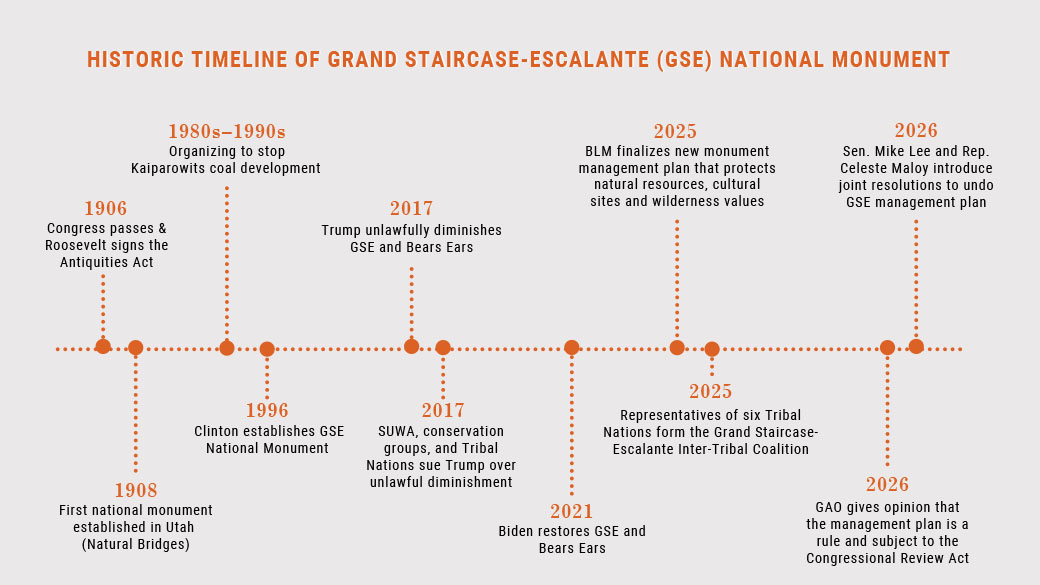
When Dutch-owned Andalex Resources entered the scene in the late 1980s, SUWA led a nearly seven-year battle to thwart the company’s massive coal enterprise at every turn by challenging permits, generating media attention, and activating our grassroots base. These actions by members and supporters laid the political and legal groundwork that made the monument’s eventual designation possible.
When President Bill Clinton signed the proclamation establishing Grand Staircase-Escalante National Monument on September 18, 1996, it capped nearly a decade of hard-fought work to protect a vast, wild, and exceptionally remote redrock landscape. The 1.9-million-acre monument was the first ever national monument entrusted to the Bureau of Land Management (BLM) following its designation, and the seed of what became the agency’s robust National Conservation Lands program.
In the years after designation, Grand Staircase-Escalante quietly proved what monument defenders knew all along: that protecting natural resources, wilderness, watersheds, wildlife, dark skies, and solitude on public lands benefits both land and people. The monument safeguards one of the most intact ecosystems on the Colorado Plateau, rich with paleontological treasures, rare plant communities, wildlife habitat, and a millennia of Indigenous cultural history.
The BLM’s conservation-focused management and landscape-scale protections helped preserve world-class fossil beds and irreplaceable archaeological resources, while nearby communities built sustainable economies around visitation, science, education, and outdoor recreation. For SUWA, the monument became both a model and a proving ground for what strong conservation of BLM lands could look like.
The 2017 Rollback and SUWA’s Response
That success—and the power of true, landscape-level protections (coupled with the illogical politics of Utah)—made Grand Staircase-Escalante a target. At the behest of Utah politicians who ignored both the overwhelming popularity of the monument and the economic engine it proved to be for the surrounding communities, President Trump signed a new proclamation in 2017 slashing Grand Staircase-Escalante by nearly half. Just over twenty years after it was designated, this proclamation unlawfully stripped protections from roughly 900,000 acres and carved the remaining landscape into three smaller units. It was one of the largest rollbacks of federal land protections in U.S. history.
Even for lands that remained part of the shrunken monument, real protection sharply declined in 2020 when the Trump administration’s BLM released a new, intentionally weak monument management plan that was structured around maximizing commodity uses, expanding roads and motorized use, and allowing for significant development and disturbance in areas still inside the monument.
That plan failed to adequately protect cultural and paleontological resources that were central to the original designation, leaving historic, scientific, and Native ancestral sites vulnerable to off-road vehicle damage, looting, and other impacts from increased development. And as for the lands that Trump excised from the monument, they were to be managed for a variety of uses, including mining, oil and gas leasing, and utility rights-of-way.
SUWA was part of a broad coalition of conservation partners, local businesses, and scientists that challenged this illegal reduction in court. While that litigation moved forward, SUWA organized its members and supporters, helping generate roughly 17,000 public comments on the new management planning process, and pressed the administration to restore the full monument.
Restoration and a New Planning Process
In October 2021, President Biden signed a new proclamation fully restoring Grand Staircase-Escalante to its original boundaries. The Biden proclamation reaffirmed that Grand Staircase-Escalante is a national treasure, strengthened acknowledgement of Indigenous ancestral ties to the landscape, and confirmed that BLM would once again manage the monument, in full, for conservation and cultural
values.
The BLM launched a new, holistic management planning process for the restored monument, with extensive outreach to Tribal Nations, local governments, and the public. The draft plan, finalized in 2025, drew overwhelming support for a conservation-focused approach that reflects the monument’s scientific, cultural, and wilderness values.
In 2025, representatives of six Tribal Nations whose ancestral homelands include Grand Staircase-Escalante announced the formation of the Grand Staircase-Escalante Inter-Tribal Coalition: the Hopi Tribe, the Navajo Nation, the Kaibab Band of Paiute Indians, the Paiute Indian Tribe of Utah, the Ute Mountain Ute Tribe, and the Zuni Tribe. The coalition was formed to both advocate for conservation of these ancestral lands and to bring Traditional Indigenous Knowledge and expertise directly into how the monument is managed.
What Makes Grand Staircase-Escalante So Special?
Often called “the science monument,” Grand Staircase-Escalante has yielded extraordinary discoveries of dinosaur species and fossilized plants and animals, making it one of the most important outdoor laboratories for understanding ancient life on Earth. The geological “steps” of the Grand Staircase are a sequence of sedimentary rock layers stretching more than one hundred miles from Bryce Canyon National Park to the depths of the Grand Canyon. The monument boasts wonders at every scale: from dinosaur bones to a remarkable diversity of native bees. The state of Utah is home to a quarter of the bee species found in the United States, and roughly half of those have been documented in Grand Staircase-Escalante, likely due to the area’s varied topography (from sun-soaked plateaus to winding slot canyons) and incredible variety of flowering plants, which includes half of the state’s rare species. Tribal Nations have stewarded these lands since time immemorial, and six Nations recently formed an inter-tribal coalition to advocate for protection of the monument. Without management plans shaped in partnership with Tribal Nations, these landscapes—and the history and heritage they hold—would be at risk. (Photo © Tom Till)
A New Threat Emerges
Incensed that the Biden administration restored protections for Grand Staircase-Escalante and finalized a management plan to implement those protections, Utah’s congressional delegation (Senators Lee and Curtis, Representatives Moore, Owens, Maloy, and Kennedy) is now turning to an obscure law in their latest attempt to undermine the monument: the Congressional Review Act (CRA).
The CRA requires federal agencies to submit “rules” to Congress for a mandatory review period before those rules take effect. Following submission, and for a limited window of time (60 “session days”), Congress can vote by a simple majority in each body to overturn or “disapprove” the rule. If that happens, and the president signs the resolutions into law, an agency cannot reissue a rule that is “substantially the same” in the future. The CRA was meant as a tool to review major regulations, not a veto power Congress can use to throw out any agency decision it doesn’t like. But that is how Congress is now using the CRA, setting a dangerous precedent not only for Grand Staircase-Escalante, but for the future of America’s public lands.
The BLM has long maintained that its land management plans are not “rules” subject to the CRA, as have other land management agencies like the National Park Service and the U.S. Forest Service. However, emboldened by a series of non-binding Government Accountability Office (GAO) opinions, some members of Congress have embraced the novel theory that federal land management plans are indeed “rules” subject to the CRA. In 2025 alone, Congress passed six CRA resolutions to invalidate resource management plans for BLM-managed land in Montana, Alaska, Wyoming, and North Dakota, throwing the management of tens of millions of acres of federal public land into chaos.
Most recently, congressional Republicans have weaponized the CRA to come after the Boundary Waters Canoe Area Wilderness in northern Minnesota. In January, the House passed a resolution to “disapprove” of a mineral withdrawal implemented during the Biden administration to prevent a proposed copper mine from polluting the watershed that feeds and supports the wilderness. As of this newsletter printing, a vote has not been scheduled in the Senate.
Not to be outdone, and in an unprecedented escalation, Utah’s congressional delegation—led by failed public lands sell-off champions Senator Lee and Representative Maloy —are now trying to use the CRA to target Grand Staircase-Escalante. In early March, they introduced “resolutions of disapproval” under the CRA to undo the current monument management plan. This is the first attempt ever to use the CRA to attack a national monument.
Their goal is nothing less than to fast-track the monument’s destruction by getting rid of its management plan, which guides everything from the protection of endangered species to the location of new campgrounds. Weaponizing the CRA to overturn the monument management plan tosses aside years of public input and Tribal consultation on how these lands should be managed for the American people, including families, hikers, scientists, hunters, and guides and outfitters.
Overturning the monument management plan could also quickly transform this area—with no input from stakeholders—into a very different landscape: one where out-of-control off-road vehicle use, powerlines, landscape-level clearcutting of native piñon-juniper forests, and other extractive activities are all possible.
Utah Business Leaders Head to DC to Advocate for Grand Staircase-Escalante
During the first week of February, as rare blizzard conditions hit Washington, DC, a team of business leaders from southern Utah braved the cold and ice to meet with House members about the importance of protecting Grand Staircase-Escalante National Monument. These restaurant owners, ranchers, large–scale employers, recreation guides, and other business owners spoke of how important the monument is to their businesses and local economies and urged legislators to oppose any efforts to undo the current management plan. After meeting with Public Lands Caucus members, Republican offices, and some Democratic offices, the business leaders also spent time distributing educational materials on Capitol Hill and recruiting cosigners for a letter (which they also drafted) opposing the introduction of a “joint resolution of disapproval” on the monument management plan. Many thanks to these business leaders for taking time away from their busy schedules to come all the way to DC and advocate for protecting Grand Staircase-Escalante!
The Fight Continues
While the CRA may be a new threat, it is just the latest one in the long fight to protect Grand Staircase-Escalante. And we certainly are not backing down now. SUWA members, supporters, staff, and conservation partners have been walking the halls of Congress and calling and emailing their representatives and senators to educate them about Grand Staircase-Escalante and the damage that invoking the CRA would cause to this quintessential and beloved redrock landscape.
We are also not naive to the very real threat that President Trump may once again abuse the Antiquities Act to illegally reduce the monument and its protections. We are ready to take up that fight again as well.
From opposing coal development on the Kaiparowits Plateau, to celebrating the 1996 proclamation, to fighting in court against the 2017 rollback, to championing a robust new management plan, to supporting Tribal voices in future management of the monument, SUWA has been there at nearly every twist and turn in the story of Grand Staircase-Escalante. That long arc of engagement—spanning more than 40 years of organizing, litigation, policy work, fieldwork, and grassroots pressure—has helped define how public lands are protected at a landscape scale.
SUWA members and supporters have done so much to keep the monument intact through rollbacks and restorations; together, we will keep it intact in the face of new, unprecedented threats in Congress. The monument’s future is not guaranteed, but the last three decades prove that when we all show up—alongside Tribal leaders, scientists, and local communities—we can prevail. Grand Staircase-Escalante’s wild canyons, mesas, and badlands have powerful defenders.
—Kya Marienfeld & Laura Peterson
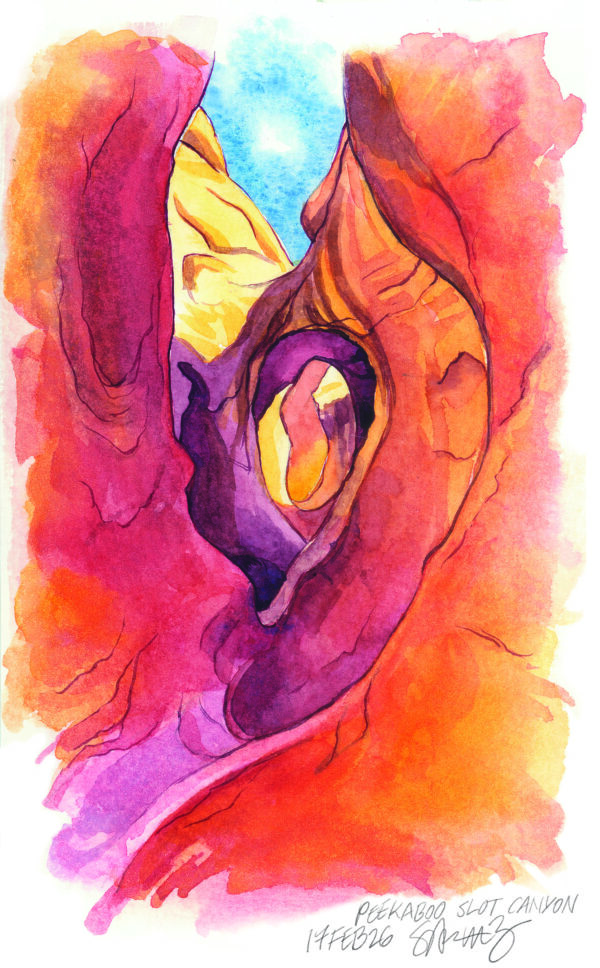
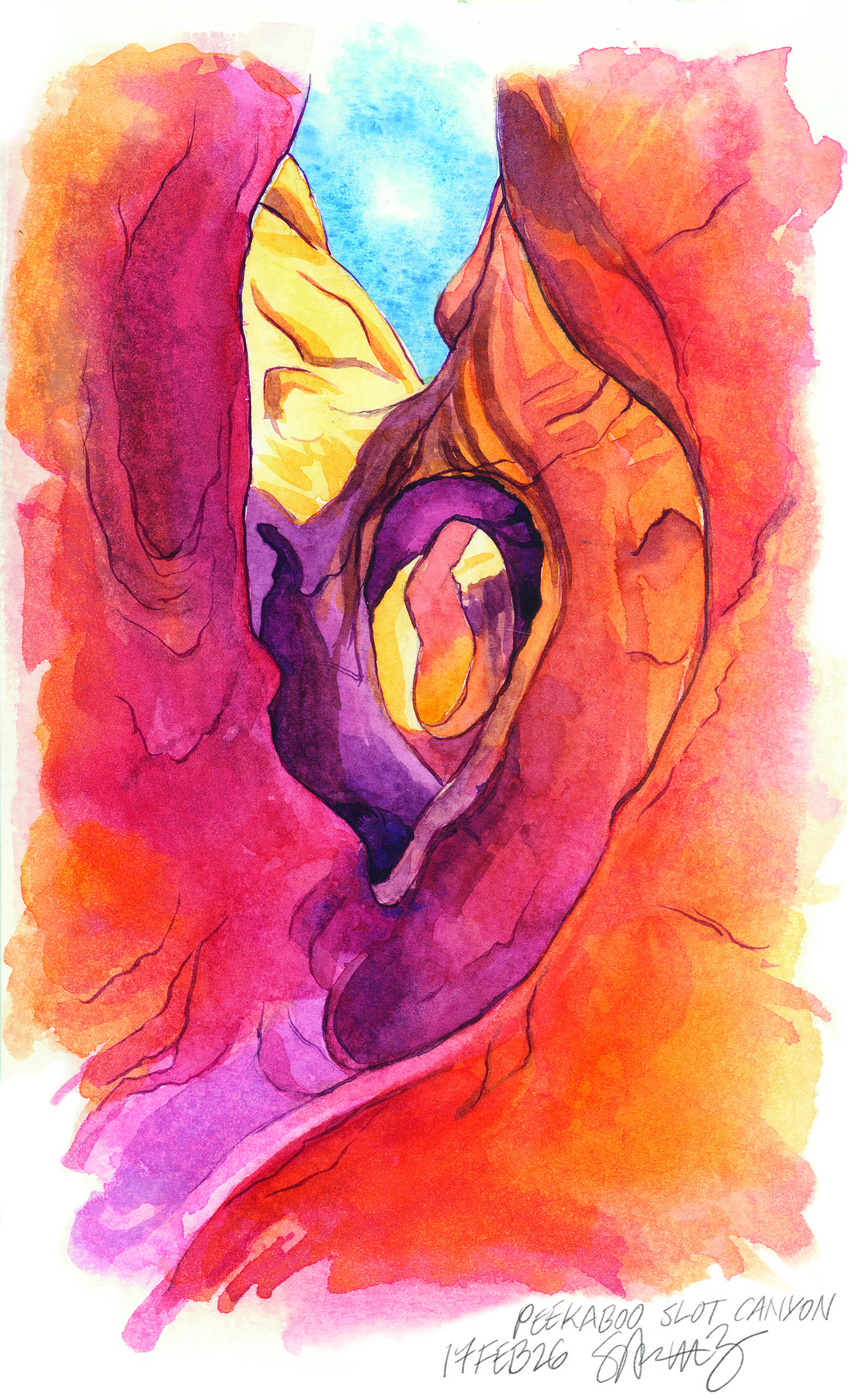
[Ed. Note: SUWA commissioned the artwork in this article for use in defense of Grand Staircase-Escalante National Monument. The artist, Samantha Zim, is an illustrator and watercolorist who lives in the Moab Valley. Learn more about Samantha and her art at www.samanthazimart.com]
The above article first appeared in the Spring 2026 issue of our Redrock Wilderness newsletter. Become a member to receive our print newsletter in your mailbox 3 times a year.