Take Action to Protect Grand Staircase-Escalante
 |
Congress isn’t in session right now, but when legislators return in early September, they’ll be working on finishing the 2026 Budget Bill. We need you to speak up and ensure that Grand Staircase–Escalante National Monument remains protected from exploitation. The House version of the bill includes a harmful provision that would undermine existing protections for this crown jewel of our nation’s public lands system.
The House 2026 Interior, Environment and Related Agencies Appropriations Bill would require the Department of the Interior to manage Grand Staircase-Escalante “in compliance with the Record of Decision and Approved Resource Management Plans . . . dated February 2020.” In practical terms, if passed, this language would require the BLM to follow a 2020 Trump administration resource management plan that does not afford monument protections for approximately 900,000 acres of Grand Staircase-Escalante. In the July edition of the Redrock Report, we shared information about a SUWA-led letter from organizations calling on the House to stop this attack.
We can make sure this doesn’t happen—but we need to act now. The Senate’s version of the Budget Bill does not include this provision, and it must stay that way. Our advocacy action urges senators to hold the line and reject any attempt to add this provision to their version of the bill; at the same time, it calls on representatives to remove the provision from the House bill.
>> Take Action: Tell Your Elected Officials to Protect Grand Staircase-Escalante!
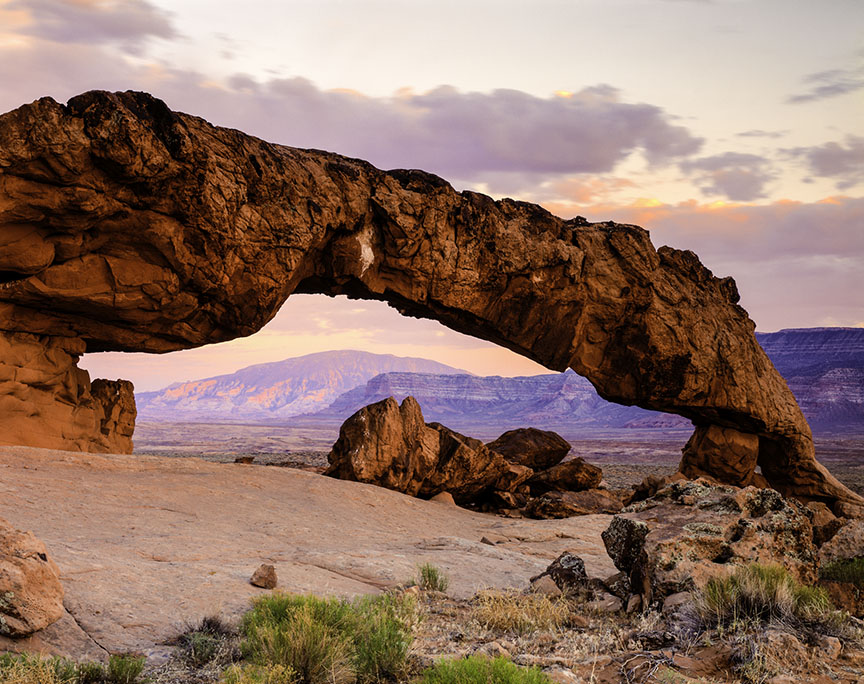
Photo © Tom Till
SUWA Challenges Destruction of 125,000 Acres of Public Land in Utah’s West Desert
|
|

In early August, SUWA filed a lawsuit in federal district court challenging the Bureau of Land Management’s (BLM) 2019 decision to approve a nearly 125,000-acre potash mining project, known as the Sevier Playa Potash (SPP) Project, as well as the BLM’s 2025 decision approving a modified version of the project. Together, the agency’s decisions set the stage for the SPP Project to impact and damage Utah’s remote West Desert for decades. The agency failed to consider the full range of environmental impacts from this large-scale industrial development—including impacts to groundwater, migratory birds, and dark night skies—in violation of federal environmental law.
Sevier Lake is located in a remote and largely undisturbed area of Utah’s West Desert within the Great Basin National Heritage Area, an area currently devoid of light or noise pollution. Like the Great Salt Lake, Sevier Lake is a highly saline terminal lake along the Pacific Flyway that serves as an important stopover point for migratory birds. Although it is fed by the Sevier River, upstream water diversions cause Sevier Lake to be largely dry during certain times of the year. The groundwater drawdown required for the SPP Project, along with the nearby proposed Pine Valley Water Supply Project, will have significant, yet unaccounted for, impacts to groundwater in this fragile desert region that could adversely affect areas as far north as the Fish Springs National Wildlife Refuge.
“By failing to conduct the required environmental analysis for a project of this magnitude, BLM has rubber-stamped a decision to irreversibly alter the extremely wild and remote nature of Utah’s West Desert,” said SUWA Staff Attorney Hanna Larsen. “The impacts of turning Sevier Lake into an industrial zone will destroy important habitat for migratory birds, ruin incredibly dark night skies, and imperil groundwater resources for decades to come.”
>> Read our full press release as well as news coverage from the Salt Lake Tribune and Utah News Dispatch.
Photo © Ray Bloxham/SUWA
Mine Threatens Proposed Wilderness in Iron County
 |
In another threat to the wild places of Utah’s West Desert region, the Bureau of Land Management (BLM) has released a draft Environmental Analysis (EA) for the proposed Modena Mine, which would be located in western Iron County, just south of Hamlin Valley along Modena Canyon Road. Despite significant local concern and potential impacts to a popular recreation area, wildlife habitat, and the main road into and out of Hamlin Valley, the BLM conducted no public scoping period for this project and initially allowed a mere 15-day comment period on the EA; this was later extended by another 2 weeks.
The proposed mine is for pozzolan, a poorly consolidated volcanic ash used as an additive for concrete. The BLM permit would be for 19.5 acres, but in March 2025, Iron County approved a 200-acre Conditional Use Permit (CUP) for the mine, and the mining company has approximately 1,120 acres of mining claims in the area. In the EA, the BLM doesn’t address this potential expansion of the Modena Mine.
The mine would impact BLM-identified wilderness-caliber lands (proposed for wilderness designation in America’s Red Rock Wilderness Act) and is in the middle of a mule deer migration route and important elk habitat. In the EA, the BLM did not analyze the impacts of the mine and its associated water use, rock crushing and hauling, water hauling, 5-acre gravel pit, dust abatement, and stream cleanout on any natural or cultural resources, or on public health and safety. The lack of environmental analysis is very concerning and, unfortunately, indicative of the administration’s pursuit of profit for mining companies over environmental considerations.
Additional information can be found on the website of Save Modena Canyon, a local community organization.
SUWA is preparing extensive comments on the draft EA, which are due on September 4th. Stay tuned for future updates on this project.
Photo © SUWA
“S” Is for September—and Stewardship!
 |
The summer season is slowly winding down, but don’t worry: our Stewardship Program has some great fall opportunities lined up for you! In particular, we’re looking for volunteers to fill remaining spaces on the following late September projects:
- Indian Creek Riparian Restoration, September 22-25 (Mon-Thurs)—Build erosion control structures to restore healthy waterways, floodplains, and plant and animal communities near Indian Creek in Bears Ears National Monument.
- Stansbury Island National Public Lands Day Clean-Up, September 27 (Sat)—Celebrate National Public Lands Day and give back to the landscapes that sustain us by cleaning up trash on Stansbury Island. This one-day project is especially convenient for our Wasatch Front supporters and those who lack time for overnight trips.
Make new friends and learn about public land conservation while enjoying the cooler weather and changing color palette of a new season. For more details and to submit an application, visit suwa.org/stewardship.
Photo © SUWA
SUWA in the News
If you’re still hungry for more news about the redrock wilderness and public lands, we encourage you to check out . . .
- This Salt Lake Tribune op-ed, Bears Ears isn’t a partisan issue. Leaders must respect tribal knowledge, from Malcolm Lehi, councilman for the Ute Mountain Ute Tribe and co-chair of the Bears Ears Commission.
- “Public Lands, Public Voice: a regional call-in show” from Rocky Mountain Community Radio, featuring SUWA Legal Director Steve Bloch as a guest.
- Two pieces: Fossil fuels expansion on federal lands leads to questions on the validity of the Trump administration’s “national energy emergency” (Rocky Mountain Community Radio) and Trump’s ‘big, beautiful bill’ is rolling back major oil and gas reforms. Here’s what that means for Utah’s public lands (Salt Lake Tribune), both of which include quotes from SUWA Staff Attorney Landon Newell.
- This piece from Public Domain, pointing out the hypocrisy of Utah’s senior senator: Sen. Mike Lee Says He’s Working To Rein In Housing Costs. His Record Tells A Different Story.
Free Online Tool Makes Legacy Giving Easier than Ever
Did you know August is National Make-A-Will Month? It’s the perfect time to reflect on the legacy you want to leave for the people and causes you love. By including a gift to a nonprofit in your will, you create a lasting impact that extends far beyond your lifetime.
When you choose to remember SUWA in your estate plans, you’re funding real-world, effective resistance and helping to ensure that public lands in Utah remain intact far into the future. Legacy gifts—whether large or small—are vital to the strength of all nonprofits, and while we would be honored to be part of your legacy, we also encourage you to consider supporting other organizations close to your heart.
To make the process easy, we’ve teamed up with FreeWill, a free online resource that helps you create a legally valid will at no cost. Visit suwa.org/plannedgiving to learn more—and know that you can include a planned gift to any organizations you care about through our portal, not just us. Together, these commitments help build a stronger, more resilient future.